

Tired of App Clutter? The 4 Best Ways to Control All Your Smart Home Devices in One Place
Building a smart home sounds simple at first. Buy a few smart bulbs, add a thermostat, maybe install a video doorbell, and everything should work together seamlessly. In reality, most households end up with devices from several different brands, each requiring its own app, account system, and automation rules.
A typical setup might include Philips Hue lights, a Nest thermostat, Kasa smart plugs, and a Ring doorbell. Individually, these products work well. Together, however, they often create a fragmented experience that forces users to constantly switch between apps just to manage basic routines.
For years, smart home platforms encouraged this kind of ecosystem lock-in. Apple users were pushed toward HomeKit-certified accessories, while Google Home and Amazon Alexa favored devices built specifically for their own ecosystems. Mixing brands usually meant sacrificing convenience or advanced automation features.
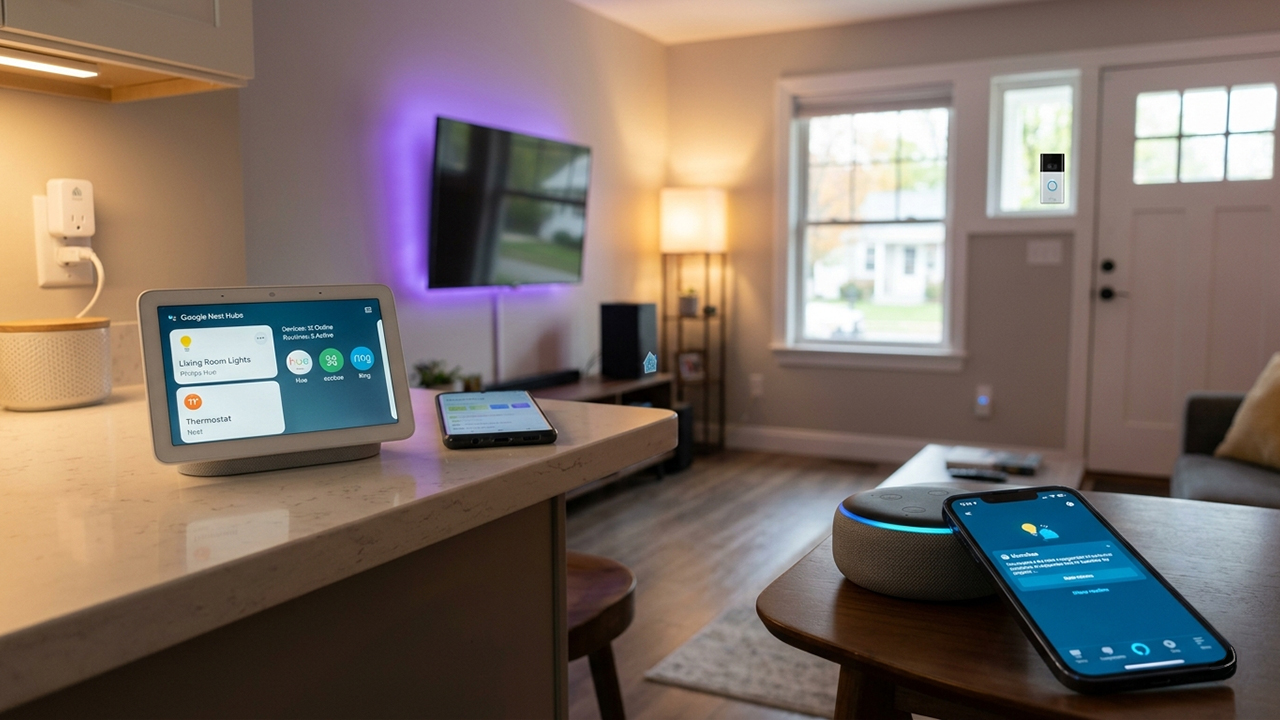
That situation has improved dramatically over the past few years. The arrival of the Matter standard, along with broader cross-platform support, has made it much easier to combine products from different manufacturers into a single smart home system. Today, users can build a setup that includes hardware from Apple, Google, Amazon, Samsung, and smaller third-party brands without being tied to a single platform.
To find the best apps for managing these mixed-device environments, the leading options were tested on both iOS and Android. The evaluation focused on device compatibility, automation reliability, interface design, responsiveness, and overall ease of use.
Here are the apps that currently do the best job of bringing disconnected smart home ecosystems together.
1. Samsung SmartThings
Available on: App store, Google Play
Pricing: Free
Despite its branding, SmartThings is no longer just a Samsung-centric platform. It has evolved into one of the most flexible and reliable smart home aggregators available, especially for households using products from multiple brands.
One of SmartThings’ biggest strengths is its automation system. During testing, it handled devices from Philips Hue, ecobee, Ring, Nest, Sonos, and TP-Link without major issues. More importantly, it allowed these devices to interact with one another in ways many native apps still cannot.
For example, a nighttime routine was configured that turned on porch lights when a Ring camera detected motion after 10 PM, while simultaneously triggering a Sonos notification sound and adjusting thermostat settings. The automation executed quickly and consistently across brands.
SmartThings also benefits heavily from Matter support, which improves compatibility and reduces dependence on cloud-based communication for supported devices.
What Works Well
Excellent multi-brand automation support
Strong Matter integration
Supports a huge range of third-party devices
Free to use without feature paywalls
Where It Falls Short
The interface can feel crowded for beginners
Advanced Zigbee and Z-Wave support may require compatible hub hardware
For most users, SmartThings strikes the best balance between simplicity and advanced functionality.
2. Amazon Alexa
Available on: App store, Google Play
Pricing: Free
Although Alexa is best known as a voice assistant, the Alexa app has quietly become one of the easiest ways to connect devices from different ecosystems.
Nearly every smart home manufacturer supports Alexa integration through Skills, making the platform unusually compatible with both mainstream and budget hardware. During testing, the app connected everything from inexpensive Tuya smart plugs to Nanoleaf lighting panels with minimal setup friction.
Alexa’s standout feature is its automation simplicity. Creating routines is fast, beginner-friendly, and requires little technical knowledge. The platform’s “Hunches” feature is also surprisingly useful. Over time, Alexa learns usage patterns and suggests automations automatically.
In testing, the app noticed lights that were regularly left on overnight and recommended automatically shutting them off at bedtime. While not groundbreaking, these small conveniences make Alexa particularly appealing for less technical users.
What Works Well
Extremely broad device compatibility
Simple routine builder
Helpful predictive automation features
Easy onboarding process
Where It Falls Short
Heavy reliance on cloud connectivity
Occasional latency during internet interruptions
The interface increasingly promotes Amazon services and products
Alexa may not offer the deepest automation tools, but it remains one of the easiest platforms for managing a mixed smart home setup.
3. Home Assistant
Available on: App store, Google Play
Pricing: Free (optional subscription available)
For advanced users, Home Assistant remains the gold standard for smart home control.
Unlike most commercial platforms, Home Assistant runs primarily on local hardware, such as a Raspberry Pi, mini PC, or home server. The mobile app functions as a companion interface for that self-hosted system.
The biggest advantage is speed and privacy. Because automations run locally rather than through remote cloud servers, device responses are often nearly instantaneous. During testing, routines involving multiple brands executed noticeably faster than equivalent setups in cloud-dependent platforms.
Home Assistant also supports an enormous number of integrations, including many devices that larger ecosystems ignore entirely. It successfully combined HomeKit-exclusive products, Zigbee sensors, Nest hardware, and older smart devices into a single dashboard.
Customization is another major strength. Users can build highly personalized control panels, dashboards, and automation systems tailored to their homes.
What Works Well
Exceptional device compatibility
Fast local automation execution
Strong privacy protections
Highly customizable interface and dashboards
Where It Falls Short
Considerably steeper learning curve
Requires dedicated hardware and setup time
Remote access configuration can be intimidating for beginners
Home Assistant is not the easiest option on this list, but for enthusiasts willing to invest the time, it offers unmatched flexibility and control.
4. Google Home
Available on: App store, Google Play
Pricing: Free
Google Home has improved substantially over the last few years. What was once a relatively limited companion app for Nest products has matured into a capable smart home platform with strong Matter support and a cleaner user experience than many competitors.
The app’s interface is one of its biggest advantages. Device organization is intuitive, and the Favorites tab makes it easy to access commonly used controls without digging through menus.
Google Home also now supports far more third-party hardware than it did previously. During testing, devices from Philips Hue, Yale, TP-Link, and several Matter-certified brands paired without major issues.
Its most powerful feature, however, is the Script Editor. Accessible through Google’s web interface, it allows advanced users to create sophisticated YAML-based automations that go far beyond the standard mobile app tools.
That flexibility enables highly specific triggers and conditions that would normally require platforms like Home Assistant.
What Works Well
Clean, modern interface
Strong Matter integration
Excellent performance across Android and iOS
Advanced automation options through Script Editor
Where It Falls Short
Some Nest-focused prioritization remains
Advanced scripting features are less accessible to casual users
Basic automation tools are still somewhat limited
Google Home is particularly appealing for users already invested in Google services who want a cleaner interface without sacrificing flexibility.
Final Verdict
Managing a smart home no longer requires committing to a single ecosystem. Thanks to broader compatibility standards and improved cross-platform support, it is now realistic to combine products from multiple brands into one cohesive setup.
For most households, Samsung SmartThings is currently the strongest all-around choice. It combines wide device support, reliable automation tools, and solid Matter integration while remaining approachable for everyday users.
For power users who prioritize privacy, local control, and maximum customization, Home Assistant remains unmatched, provided they are willing to handle the additional setup complexity.
Meanwhile, Amazon Alexa and Google Home continue to improve rapidly and are both excellent choices depending on existing hardware preferences and ecosystem familiarity.
The most important shift is that users no longer need to build their smart home around a single company’s ecosystem. The best devices from different brands can finally work together with far less friction than before.