

No Hookups, No Problem: The 5 Best Apps for Finding Free Campsites and RV Dump Stations
For RV travelers, freedom on the open road comes with one unavoidable reality: eventually, the tanks need emptying, and a place to park for the night needs finding. That sounds simple in theory, but in practice, locating a reliable RV dump station or a legal free campsite can quickly turn stressful — especially in unfamiliar areas with weak cell service.
Modern camping apps aim to solve that problem by helping RVers locate dump stations, dispersed camping areas, overnight parking spots, and public land access points. But not every app performs equally well once travelers leave major highways behind.
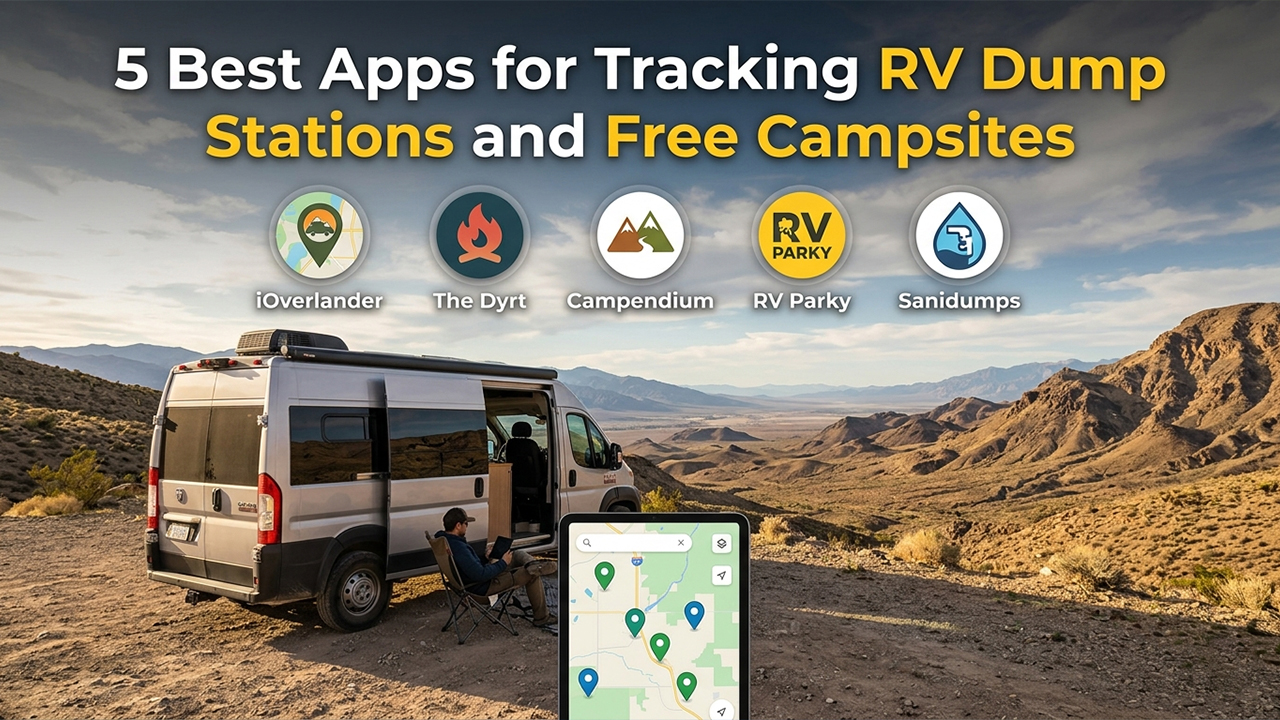
To identify the most useful tools for real-world RV travel, several popular apps were evaluated based on:
Database accuracy
Offline functionality
Ease of navigation
Quality of community updates
Usefulness for both dump stations and free camping
After extensive comparison, these five apps stood out as the best options for RVers in 2026.
1. iOverlander
Availability: iOS & Android
Pricing: Free
What Makes It Useful
Among experienced RVers and overlanders, iOverlander has earned a reputation as one of the most practical crowd-sourced travel apps available.
Instead of focusing mainly on commercial campgrounds, the app specializes in real-world traveler information: dispersed camping pullouts, free overnight parking areas, potable water stops, propane refills, and RV dump stations.
Its biggest advantage is the level of detail contributed by the community. Users frequently leave highly specific notes that traditional campground directories overlook, including:
Tight turns for large rigs
Muddy road conditions
Broken dump station equipment
Noise levels
Recent law enforcement activity
Cellular signal quality
That type of firsthand information becomes extremely valuable in remote areas.
The app also performs surprisingly well in places with limited infrastructure, including rural regions across the United States, Canada, and Mexico.
Pros
Completely free with no major paywalls
Excellent crowd-sourced updates
Strong coverage for off-grid travel
Useful beyond camping alone
Cons
Interface feels dated compared to newer apps
Search tools can feel clunky
Map-heavy navigation takes time to learn
2. The Dyrt
Availability: iOS & Android
Pricing: Free basic version; PRO subscription available
What Makes It Useful
The Dyrt combines campground discovery with polished trip-planning tools, making it especially appealing for newer RV travelers.
The free version works well for finding public and private campgrounds, but the PRO membership unlocks the features that matter most for boondockers and off-grid campers.
The standout addition is public land mapping. PRO users can view Bureau of Land Management (BLM) and U.S. Forest Service boundaries directly inside the app, helping travelers confirm whether dispersed camping is actually permitted.
That added layer of certainty is incredibly useful when camping in unfamiliar western states where land rules can change rapidly across short distances.
The app also includes detailed campground reviews, high-quality photos, and filters for:
RV length
Cell service quality
Pet access
Amenities
Dump station availability
Pros
Clean, modern interface
Excellent campground reviews and photos
Helpful public land overlays
Strong offline tools in PRO version
Cons
Best free camping tools require a subscription
Less effective for informal overnight parking
Premium features can feel expensive for casual travelers
3. Campendium
Availability: iOS, Android & Web
Pricing: Free basic version; Premium subscription available
What Makes It Useful
Campendium is particularly well-suited for RVers who balance remote camping with remote work.
Its strongest feature is arguably its cell coverage reporting system. Before driving miles down a rough dirt road toward a campsite, travelers can check real user reports showing carrier performance for Verizon, AT&T, and T-Mobile.
That level of connectivity insight has made Campendium especially popular among digital nomads and full-time RVers.
The app also organizes campgrounds clearly by category, allowing users to separate:
Free dispersed camping
RV parks
Casino overnight parking
Public campgrounds
Dedicated dump stations
Compared with some competitors, Campendium feels more curated and organized, which makes trip planning easier.
Pros
Excellent cell service reporting
Strong campground categorization
Helpful RV-focused filters
Reliable dump station listings
Cons
Advanced map tools are paywalled
Some reviews become outdated over time
Less useful internationally
4. RV Parky
Availability: iOS, Android & Web
Pricing: Free
What Makes It Useful
RV Parky focuses less on scenic wilderness camping and more on practical road-trip logistics.
For travelers covering long highway distances, it excels at identifying convenient overnight stops and nearby dump stations without overcomplicating the experience.
The app includes:
RV parks
Rest areas
Travel plazas
Walmart parking locations
Cracker Barrel overnight stops
Truck stops with dump facilities
Its straightforward layout makes it easy to use quickly during active travel days.
Another major advantage is route planning. Users can build an entire trip and view stops along the way instead of searching location by location.
Pros
Completely free
Excellent for highway travel planning
Reliable overnight parking information
Simple interface with practical tools
Cons
Limited wilderness camping detail
Fewer advanced outdoor mapping features
Community updates can lag in some regions
5. RVingLife Sanidumps
Availability: iOS & Android
Pricing: Free with ads
What Makes It Useful
When the priority is specifically finding an RV dump station — not campsites, hiking trails, or campground photos — RVingLife Sanidumps remains one of the most specialized resources available.
The platform is built around a long-running sanitation database that tracks dump stations across the United States and Canada, including:
Campgrounds
Gas stations
Rest areas
Travel centers
Municipal facilities
Its biggest strength is focus. While many camping apps treat dump stations as secondary information, Sanidumps puts sanitation front and center.
That specialization makes it especially valuable during emergencies when travelers need the closest available dump station quickly.
Pros
Extremely comprehensive dump station database
Clearly identifies free vs. paid stations
Useful for emergency route adjustments
Includes campground directory support
Cons
Interface feels outdated
Android users rely mainly on the web version
Less useful for broader trip planning
Final Verdict
Each of these apps serves a slightly different style of RV travel.
iOverlander is the best overall free option for off-grid exploration and crowd-sourced travel intelligence.
The Dyrt PRO offers the best public land tools and polished camping experience.
Campendium is ideal for RVers who need dependable cell service information while traveling.
RV Parky works best for practical highway routing and overnight stops.
RVingLife Sanidumps remains one of the strongest dedicated dump station databases available.
For most RV travelers, combining two apps tends to produce the best results. Many experienced RVers use iOverlander for discovering free campsites and hidden resources, while relying on either The Dyrt or Campendium for planning and verification.
Because once the tanks are full and the sun is going down, having accurate information matters a lot more than flashy design.