

Before You Move In: 3 Best Apps for Checking Crime Rates Around Apartments
Finding the right apartment is already stressful. Renters have to balance budget, commute times, apartment size, and lease terms — all while competing with dozens of other applicants. But before any of those factors matter, there is one question that deserves attention first: How safe is the neighborhood?
A rental listing can look perfect online, and a neighborhood might feel quiet during a daytime tour. But safety can vary dramatically depending on the time of day, nearby streets, and long-term crime trends. Since landlords and leasing agents are often unwilling — or legally unable — to discuss local crime statistics in detail, renters usually have to research this information themselves.
That is where neighborhood safety apps can help. The best apps combine public crime reports, historical statistics, and real-time incident tracking to give renters a clearer picture of an area before signing a lease. After testing several popular options, these three apps stood out for their reliability, usability, and depth of information.
1. Crime and Place: Stats & Map
Available on: App store
Why It Stands Out
For renters, understanding long-term neighborhood trends matters just as much as knowing about recent incidents. Crime and Place: Stats & Map focuses heavily on historical crime data and visual analysis, making it especially useful for evaluating unfamiliar neighborhoods.
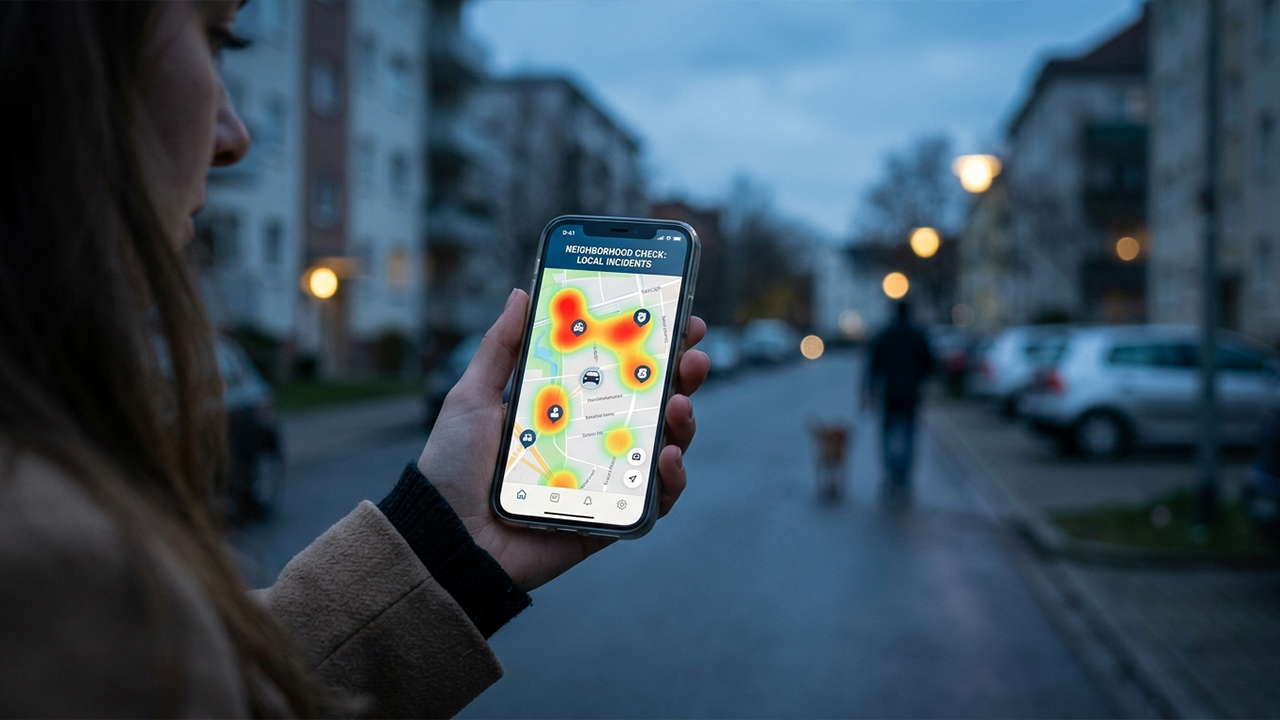
The app’s main feature is its interactive Crime Heat Map, which uses official crime statistics — including FBI data — to highlight areas with higher or lower crime activity. During testing, the map made it easy to compare nearby neighborhoods block by block instead of relying on vague citywide averages.
One of the app’s more distinctive tools is the Crime Compass™, which changes color dynamically as users move through an area. Green zones indicate relatively lower crime activity, while yellow and red areas suggest elevated risk levels. For renters visiting apartments in person, this feature adds useful context during neighborhood walkthroughs.
The app also includes a Crime Forecast feature that attempts to estimate whether local crime trends are improving or worsening over time. While predictive tools should always be treated cautiously, they can still provide additional perspective when comparing multiple neighborhoods.
Pros
Clear heat-map visualization: Makes it easy to spot higher-risk blocks or corridors quickly.
Custom crime filtering: Users can prioritize specific categories such as violent crime, theft, or property crime.
Location-based alerts: Sends notifications when entering areas with elevated crime activity.
Cons
iPhone only: No Android version is currently available.
Subscription required: Many advanced features are locked behind a paid plan, which may feel expensive for short-term apartment hunting.
2. Neighborhood Check
Available on: App store
Why It Stands Out
While many crime apps focus only on police reports, Neighborhood Check takes a broader approach. It combines crime data with demographic, environmental, and community information to help renters evaluate the overall quality of a neighborhood.
In testing, the app provided detailed breakdowns of local crime activity, including timestamps and incident descriptions pulled from municipal police departments. But its biggest strength is the additional context layered into the experience.
Users can also view nearby school ratings, household income estimates, population trends, environmental concerns, and other neighborhood indicators. For renters planning a long-term move — especially families — this wider perspective can be valuable.
The app’s map system is particularly detailed, allowing users to zoom from citywide trends down to smaller neighborhood sections and street-level areas.
Pros
More than crime data: Includes schools, demographics, and environmental information.
Detailed mapping tools: Offers neighborhood-level and block-level analysis.
Frequent updates: Data coverage continues expanding across major US metro areas.
Cons
Many premium-only features: Advanced reports and analytics require a subscription.
Can feel data-heavy: The interface may overwhelm users who only want quick safety insights.
3. SpotCrime+ Crime Map
Available on: App store, Google Play
Why It Stands Out
For renters who want a simple and free option, SpotCrime+ Crime Map remains one of the most practical choices available. Instead of emphasizing predictive analytics or demographic research, the app focuses on straightforward crime reporting and broad geographic coverage.
During testing, entering a rental address immediately populated the map with recent incidents nearby. Crimes are represented with clear icons for categories such as theft, burglary, assault, vandalism, and arrests, making patterns easy to identify at a glance.
Unlike some competitors, the app avoids overcomplicated charts and scoring systems. That simplicity makes it especially useful for quickly checking multiple apartment listings across different cities.
Another useful feature is its alert system, which can notify users when new incidents are reported within a selected radius around a neighborhood or property.
Pros
Free to use: Core features are available without a subscription.
Easy-to-read maps: Incident icons make patterns easy to understand quickly.
Wide coverage: Aggregates public crime data from many police departments and public agencies.
Cons
Data quality depends on local reporting: Smaller police departments may provide incomplete information.
Limited analytics: Does not offer advanced forecasting or trend analysis tools.
Final Verdict
Each app approaches neighborhood safety differently, so the best choice depends on what kind of renter you are.
For renters who want deeper analysis and long-term crime trends, Crime and Place: Stats & Map offers the most sophisticated tools. Its heat maps and forecasting features provide a broader understanding of how a neighborhood may be changing over time.
For users who want additional lifestyle and demographic context alongside crime statistics, Neighborhood Check provides the most comprehensive neighborhood overview.
Meanwhile, renters looking for a simple, free, and widely available option should consider SpotCrime+ Crime Map. It delivers fast access to recent local incidents without overwhelming users with excessive data or subscription barriers.
No app can guarantee personal safety, but using reliable crime data before signing a lease can help renters make more informed decisions — and avoid unpleasant surprises after moving in.